If you're running a small reseller book — somewhere between 4 and 400 seats — the math has gotten ugly. TCR brand and campaign fees, STIR/SHAKEN attestation overhead, and platform minimums that assume you're moving real volume are squeezing margins to zero. The question isn't whether to keep going. It's whether your upstream is built for you or built for the guy three tiers up.
Here's what actually matters when you're shopping a bulk DID provider at your scale.
No minimums, or get out
The single fastest way to know a provider doesn't want your business is a monthly commit. Doesn't matter what the number is — if you're billed for capacity you're not using, you're subsidizing somebody else's growth plan.
What to ask before you sign anything:
- Is there a monthly minimum spend, or a minimum number of DIDs?
- Are there per-account, per-trunk, or per-tenant fees that stack?
- What's the cancellation window — month-to-month, or annual?
- Is there a setup fee, and is it waived after volume kicks in?
A provider with a slightly higher per-number rate and no floor is almost always cheaper than one with a headline-friendly rate and a hard minimum, unless you're actually moving that volume. Run the spreadsheet before the sales call, not after.
Transparent line items, including the ones nobody mentions in a quote
A headline rate is a marketing number. The real cost stack usually includes:
- Monthly DID rental (local vs. toll-free)
- Per-minute inbound termination
- Outbound origination (often tiered by destination)
- E911 provisioning, per number, per month
- CNAM dip fees on inbound
- SMS/MMS per-segment, plus carrier pass-through
- 10DLC brand + campaign fees
- STIR/SHAKEN attestation (sometimes bundled, sometimes not)
Get a sample invoice from a provider before you commit. Not a quote — an actual invoice from a current customer with similar volume. If they won't share a redacted one, that tells you something. Our bulk DID program is structured the way an invoice would read, on purpose.
Compliance handled, or at least subsidized
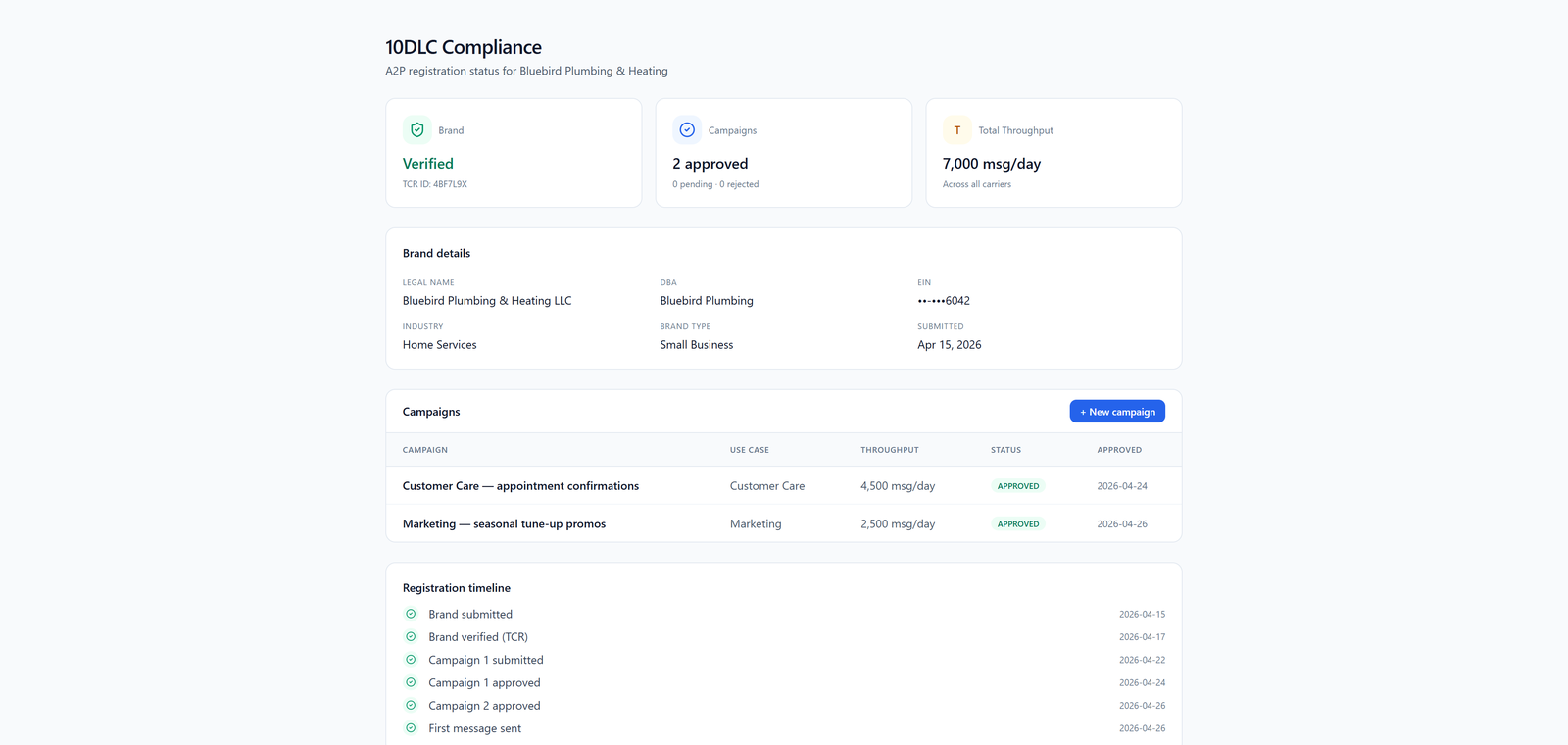
This is where small resellers are bleeding out right now. TCR brand registration and campaign vetting fees apply per downstream customer, plus carrier pass-throughs. Multiply that by every downstream business that wants to send a single SMS, and your low-tier monthly plans aren't plans anymore.
What to look for from your upstream:
- Do they submit brands and campaigns on your behalf, or do you DIY through TCR?
- Are 10DLC fees passed through at cost, or marked up?
- Is STIR/SHAKEN attestation included, or extra per-call?
- Do they handle CNAM registration, or punt that to you?
- If a customer gets a campaign rejected, who fixes it?
If you want the deep version of how messaging registration actually shakes out at the carrier level, the carrier SMS approval requirements post walks through it. The short version: you want a provider that absorbs the operational drag of 10DLC, not one that just resells you the API.
Porting that actually works
Number portability is the test of whether a provider sees you as a customer or an inconvenience. Small resellers move customers in and out constantly — losing a recurring account because a port took three weeks and the customer's old provider rejected the LOA twice is a real and recurring problem.
What to verify:
- Are port-in fees per number, per order, or waived?
- What's the typical port-in window for local DIDs? Toll-free?
- Do they support project ports (50+ numbers as one order)?
- Is there a portal you can submit LOAs through, or is it email tag with a CSR?
- When a port rejects, do you get an actual reason code, or "contact your losing carrier"?
Port-out fees are the other half. A provider that charges a meaningful fee per number to release a port is locking your customers in by making it expensive for you to leave. That's a red flag, even if you have no plans to switch.
Support that scales down, not just up
The big legacy reseller platforms are built for resellers doing real volume. When you're at four customers, you're routed to a Tier 1 queue that doesn't know your name. The CSR doesn't know your switch config. Tickets sit for 48 hours.
Ask these questions and listen carefully:
- Is there a direct channel for resellers — Slack, dedicated email, named rep?
- What's the average first-response time on a P2 ticket?
- Do they have an emergency line for outages, or do you file a ticket and pray?
- Can you escalate without going through a script?
The answer should not be "open a ticket in the portal." If you're the one your downstream customer calls at 2 a.m., you need to be able to reach a human at 2:05.
API and provisioning that doesn't require a project manager
If you're going to grow past your current book, you need to provision without filing tickets. That means:
Provisioning isn't the only place call quality can quietly degrade either — termination routing matters just as much, and T-Mobile completion across wholesale carriers is worth understanding before you lock in an upstream.
- A real REST API for ordering DIDs, configuring routes, and pulling CDRs
- Bulk operations (order 50 numbers in one call, not 50 calls)
- Webhook callbacks for porting status, SMS delivery, billing events
- A test/sandbox environment so you don't burn live credits debugging
If the only way to add a number is to log into a portal and click around, you'll spend more on labor than on the numbers themselves. Even a four-customer reseller benefits from scripting the boring parts — you'll thank yourself the day customer five shows up.
The VoIP buyers guide for distributed teams covers some of the same provisioning questions from the end-customer side, which is useful context for what your downstream is going to ask you about.
What to do next
If you're already in the squeeze — TCR fees eating margin, platform minimums you're not hitting, customers asking why their messages aren't delivering — the practical move is to spend two hours this week pulling your last three months of invoices and breaking out cost-per-customer. Anywhere your margin compression is meaningful, you're either underpricing your downstream or overpaying your upstream.
Then shop. Get sample invoices. Ask the porting questions. Ask the compliance questions. Don't sign anything with a minimum until you've talked to a provider that doesn't have one. The market for wholesale numbers has more competition than it did three years ago, and the providers built for small resellers are the ones worth your time.